
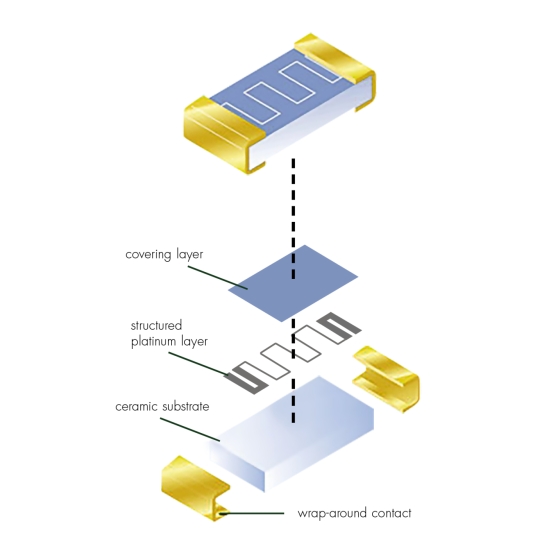
Platinum chip temperature sensors belong to the category of temperature sensors in thin-film technology. In the manufacture of these temperature sensors, a thin layer of platinum is deposited on a substrate of high-purity aluminium oxide ceramic and structured in a meandering pattern.
The temperature sensors are based on a temperature-dependent resistance whose curve and permissible tolerance are defined in the international standard IEC 60751:2008. The thin-film technology used enables the production of particularly small and robust designs. They are characterised by a favourable, linear characteristic curve, a wide temperature measuring range and a high measuring accuracy with a very good long-term stability.
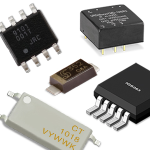
Jumo's temperature sensors are supplied in tape packaging in standard rolls. The PCS type sensor is available as a wrap-around contact or with a contact on one side as a PCF type (flip chip) for face-down installation. The flip chip types can be provided with a completely solderable nickel-gold metal layer on the back or bottom side. This enables direct thermal contact with another body via a solder connection.
Applications are in the field of e-mobility, in sensory solutions, as temperature sensors and PCBs. They are designed for the temperature range from -50 °C to +150 °C. The enlarged temperature range extends from -70 °C to +250 °C. The sensors are available in tolerance classes F0.1, F0.15, F0.3 (standard) and F0.6. In SMD versions, the temperature sensors are available as type 1206 (3216M) and 0805 (2012M). The nickel solder contacts are gold-plated. The solderability complies with IEC/DIN EN 60068-2-58 and the strap packaging with DIN IEC 60286-3.